Why Does A Price Ceiling Usually Result In A Deadweight Loss
Why Does A Price Ceiling Usually Result In A Deadweight Loss. P* shows the legal price the government has set, but mb shows the price the marginal consumer is willing to pay at q*, which is the quantity that the industry is willing to supply. B) a deadweight loss triangle whose corners are acd.
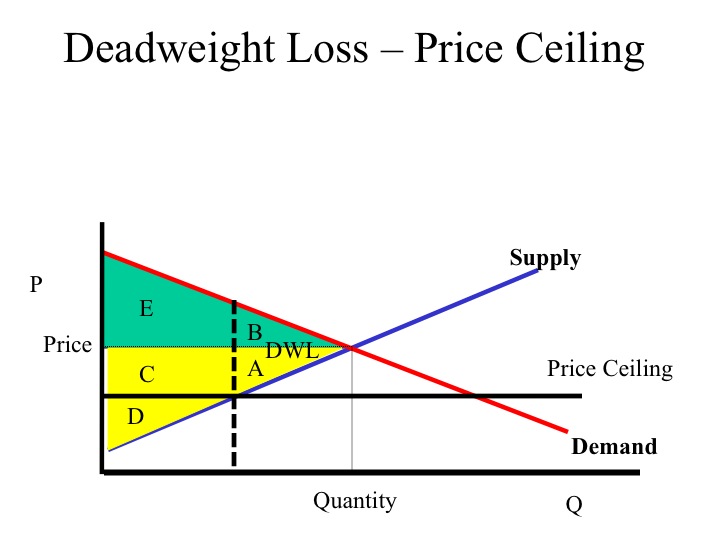
Net loss of consumer and producer​ surplus; A price ceiling creates deadweight loss deadweight loss deadweight loss refers to the loss of economic efficiency when the optimal level of supply and demand are not achieved. An example of a price floor would be minimum wage.
D) A Deadweight Loss Triangle Whose Corners Are Cde.
Price ceilings and rent controls can also create deadweight loss by discouraging production and decreasing the supply of goods, services, or housing below what consumers truly demand. The government sets a limit on how low a price can be charged for a good or service. Y1/ib 29) subsidy and deadweight welfare loss
Deadweight Loss Isa O A.
Suppose the equilibrium price of potatoes is $5 per pound, but the government imposes a price ceiling of $2 per pound, creating a deadweight loss. A second change from the price ceiling is that some of the producer. It is the excess burden created due to loss of benefit to the participants in trade which are individuals as consumers, producers or the government.
There Is A Demand For That Supply.
Deadweight loss is the loss that occurs when the occurrence of supply and demand are not in equilibrium that can result in market inefficiency. That is, they do not. Ceiling set below the equilibrium price in a perfectly competitive market will result in a deadweight loss because it reduces the quantity supplied by producers.
Deadweight Loss Is Mainly Used To Evaluate How Well A Market Is Functioning.
It states about the unavailable benefits to any party of the market society. Price ceiling is the term used for limit indication that how high a charge price can be for a service or product. Net loss of consumer and producer​ surplus;
P* Shows The Legal Price The Government Has Set, But Mb Shows The Price The Marginal Consumer Is Willing To Pay At Q*, Which Is The Quantity That The Industry Is Willing To Supply.
That is, they are price searchers or price makers. In general, deadweight loss is often as a result of government policies such as price floors, price ceilings, taxation, and subsidies. Net loss of social surplus;

0 Comments